
Why Can’t I Find a Holster for My Gun With a Light?
You bought a light or laser, attached it to your gun, and everything fits. Then you started looking for a holster—and discovered that your particular combination is surprisingly difficult to find.
Maybe you can find dozens of holsters for the gun without a light. Maybe the holster companies you checked support other products from the same light manufacturer, but not yours. You may even have offered to send someone your accessory, only to learn that borrowing it would not solve the problem.
A light fitting your firearm and a holster maker supporting that combination are two different things. Holster support depends on access to the actual equipment, suitable forming tooling, development time, physical testing, and enough demand to justify the investment.
At DME Holsters, we regularly answer questions about unusual firearm, light, and laser combinations. This guide explains why some setups are widely supported, why others are difficult to accommodate, and what options you have.
Why the Exact Gun-and-Light Combination Matters
A light-bearing holster must accommodate the combined shape of the firearm and its attached accessory. It is not simply a standard gun holster with a little extra room underneath.
The light’s body, mounting hardware, switches, and position on the rail all affect the shape the holster needs to accommodate. The relationship between the light, trigger guard, and muzzle matters as well.
The same light can attach to several different firearms without sitting in precisely the same position on each one. Different firearm models, rail arrangements, and mounting adapters can change the setup.
Likewise, two lights that look almost identical may have different dimensions, controls, or attachment hardware. Similar model names do not establish compatibility. Occasionally, related models can share a holster design, but that should be confirmed through testing rather than assumed from appearance.
The question is not just “Do you make a holster for this gun?” It is “Do you support this exact gun with this exact accessory?”
Our supported firearms, lights, and lasers list is a starting point. Check the options on the individual product page, and ask us if your particular combination is unclear.
Why Popular Lights Usually Have More Holster Options
Every new accessory represents a development decision for a holster maker. Before accepting orders, the maker needs a practical way to form and test a holster for it.
A popular light may generate orders across many firearm models. That gives the maker more opportunities to recover the cost of acquiring the accessory and developing support for it.
An uncommon light may generate only an occasional request. The development work still needs to be done, but there may be very few orders to cover it.
This does not necessarily mean the uncommon light is poorly made or unsuitable for the customer’s needs. It means that accessory sales and holster availability do not always grow together.
A light manufacturer can release a product that attaches to numerous firearms. Holster makers then face the separate task of deciding which combinations they can realistically develop, test, and maintain.
What Goes Into Supporting a New Light or Laser?
Adding an accessory to a product dropdown is the easy part. The work that makes that selection meaningful happens before the customer places an order.
Depending on the maker’s process and existing tooling, supporting a new combination may involve:
- Acquiring the actual light or laser and the appropriate mounting hardware.
- Checking how it fits the supported firearm.
- Capturing or developing an accurate model of the combination.
- Designing suitable forming tooling.
- Producing and organizing the physical molds.
- Making sample holsters and checking their fit.
- Revising the tooling when testing identifies a problem.
- Retaining the equipment for future production and quality control.
One accessory can also lead to multiple tooling configurations. Different firearms, left- and right-handed holsters, and different carry styles may require additional development.
The investment therefore extends beyond the purchase price of the light. It includes labor, materials, equipment time, testing, and space to store the accessory and its tooling.
For a setup requested frequently, that investment may be practical. For a combination requested once, recovering all of those costs through one holster can make the project substantially more expensive than a normal order.
Why a 3D Scan Is Only the Starting Point
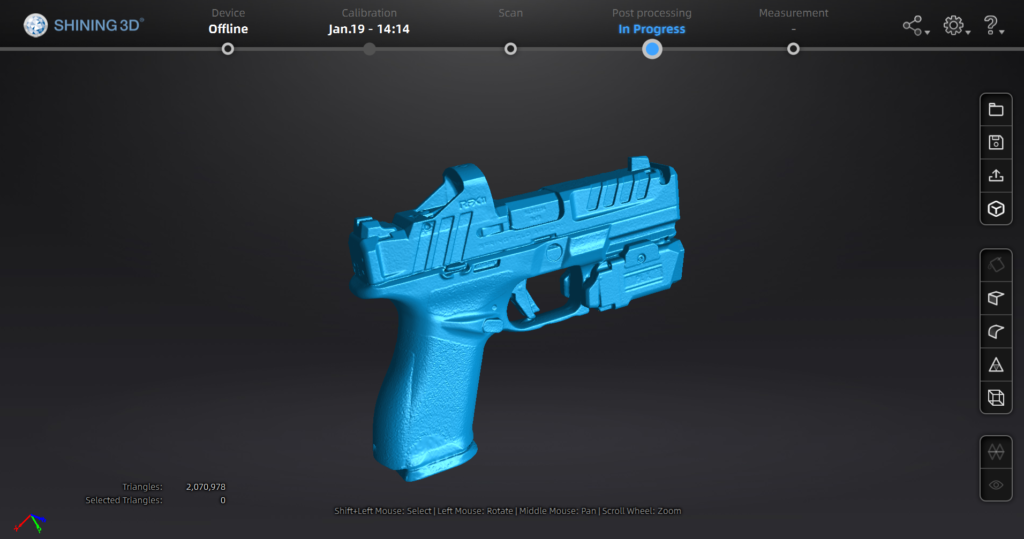
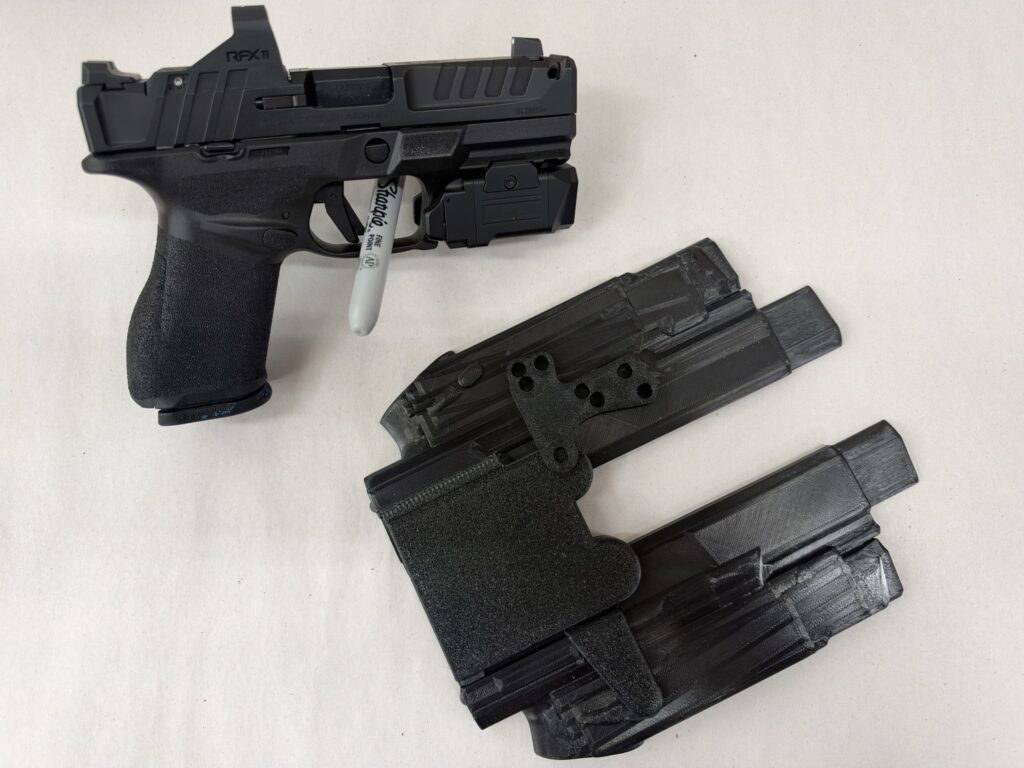
At DME Holsters, we use 3D scanning, computer-aided design, and 3D printing to develop our forming molds in-house.
A scan captures the physical shape of the equipment. However, the shape of the firearm and light is not automatically a finished production mold.
The tooling must account for how the holster forms around the equipment and how the firearm enters and leaves the finished holster. It also needs to accommodate the selected holster style and mounting arrangement.
That requires design work after scanning. Physical tooling must then be produced, and the resulting holster must be tested.
A detailed digital model can help us develop a holster, but the completed product still needs to work with the actual firearm and accessory. A design that looks right on a computer screen is not enough to establish fit.
Why DME Holsters Must Own and Keep the Accessory
Customers sometimes ask whether they can send us their light or laser so we can make a holster and return everything together.
That sounds reasonable for an individual project. For our production process, however, temporary access does not meet the ongoing need.
We need to own and retain each supported light or laser for continued fit testing and quality control. Once a borrowed accessory goes back to its owner, it is no longer available to check future holsters or investigate a fit question.
Keeping a digital scan does not replace keeping the physical accessory. Neither do published measurements or photographs. Those can assist development, but they do not let us test a completed holster with the real equipment.
Supporting a combination means being prepared to produce it again and stand behind the fit. It is a continuing commitment, rather than a single opportunity to capture its shape.
For that reason, a customer’s offer to lend us an accessory does not automatically make a new combination practical for us to support.
How Light and Laser Manufacturers Can Help
Manufacturer cooperation can make a meaningful difference in whether a holster maker can add support for an accessory.
Providing an evaluation unit, demonstration sample, or discounted accessory that the maker can retain reduces the cost of establishing a permanent testing setup.
A nonfunctioning sample may also be useful if its exterior, mounting hardware, and controls accurately match the production product. For holster fit testing, an accurate physical example can matter more than whether its electronics operate.
However, an incomplete or dimensionally different sample may not provide what the maker needs. The purpose is to develop and check holsters against the same physical configuration the customer will use.
Providing an accessory does not eliminate the design, tooling, and testing work. It removes one obstacle and can make that remaining investment easier to justify.
If you own an uncommon light or laser, ask its manufacturer which holster companies support your firearm combination. That is often more useful than assuming every custom holster shop can accommodate it.
Five Holster-Forming Methods—and Why They Matter
“Custom Kydex holster” describes a broad category of products. It does not tell you exactly how a maker forms the material or how much tooling development is required.
Holster makers use several methods, from basic foam presses to matched compression tooling. Each has different equipment requirements and production characteristics.
1. Manual Foam Press
A manual foam press uses compressible foam to apply pressure around the forming mold and heated holster material.
This approach can be accessible for smaller shops and individual projects. A skilled maker with accurate tooling can produce an excellent holster using a basic foam press.
The quality still depends on the maker’s preparation, forming work, finishing, and testing. Basic equipment does not automatically mean basic results.
2. Hinged Book Press
A hinged book press, such as a CoffeeBum-style press, closes around the tooling and material and uses clamps to apply pressure.
It provides a different press arrangement while remaining useful for hands-on custom work. As with a manual foam press, the maker’s skill and the accuracy of the forming setup remain central to the result.
A maker using this type of equipment may be able to approach an unusual one-off project differently from a shop organized around a large library of production molds.
3. Vacuum Forming With a Separate Membrane
In this method, a separate flexible membrane draws the heated material against the forming molds under vacuum. The setup can use separate mold halves to form the required surfaces.
This introduces additional equipment and tooling considerations. It can help a maker achieve consistent forming across repeated production.
Developing an uncommon combination still requires suitable molds and physical testing. Vacuum equipment does not remove those requirements.
4. Vacuum Forming With the Holster Material as the Membrane
In another vacuum-forming approach, the heated holster sheet itself serves as the membrane or vacuum barrier and is drawn against the tooling.
Although both approaches use vacuum, this differs from forming beneath a separate flexible membrane. The tooling and forming arrangement must suit the particular method.
That distinction helps explain why a mold or setup useful to one maker may not transfer directly to another maker’s production system.
5. Matched Positive and Negative Compression Molds
Matched compression tooling uses corresponding positive and negative mold surfaces to press the material into the intended shape.
This requires development of matching tooling surfaces, representing another level of preparation before production begins.
Such equipment can support detailed, repeatable forming. Whether the investment makes sense depends on the maker’s products, production volume, and business model.
Does More Sophisticated Equipment Mean Better Fit?
Not necessarily. More sophisticated forming systems can improve surface definition, repeatability, and production efficiency. Those advantages should not be confused with a guarantee of better fit.
A holster with crisp external detail can still have a fit problem. A less sharply defined holster can fit and function very well.
Accurate tooling, appropriate clearances, the maker’s skill, and completed-product testing matter across all five methods. An experienced foam-press maker can produce excellent work.
The important difference for an unusual setup is how much preparation a particular maker needs before making that first holster.
Why a Local Maker May Be Able to Help With a One-Off Holster
A local custom maker may organize the business around individual projects rather than repeat production of a large number of listed combinations.
That can create options for a customer whose accessory is too uncommon for a production shop to add permanently.
A maker using a foam or hinged book press may have a practical approach to a one-off job, provided suitable forming props and a way to verify the completed fit are available.
This is a difference in workflow and business model. It does not establish that one maker’s holsters are better than another’s.
Ask the maker about experience with your exact setup, suitable tooling, the project price, and how the completed holster will be checked.
Polymer Frames Need Appropriate Forming Props
There is an important distinction between using a firearm for completed-holster fit testing and using it as the object inside a heated press.
Polymer-frame firearms should not be subjected directly to the heat and pressure of holster forming. The frame can be damaged or distorted.
Accurate, purpose-made forming props are the appropriate approach. A suitable commercial molding prop or an accurately configured alternative must represent the areas that affect holster fit. A training replica should not be assumed accurate enough simply because it resembles the firearm.
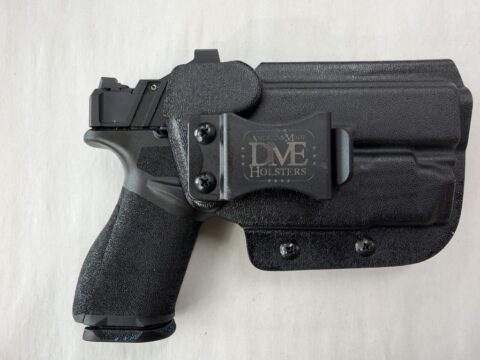
The finished holster should then be checked for fit, retention, trigger coverage, and clearance for the attached equipment.
Check Holster Support Before Buying a Light or Laser
If you have not purchased the accessory yet, checking holster availability first can save considerable frustration.
Start with the combination you actually intend to carry, including the holster style and any additional equipment.
- Firearm: Identify the exact model, version, and barrel length.
- Light or laser: Use the full model name, including any version or variant designation.
- Mounting: Identify any adapter or unusual mounting arrangement.
- Carry style: Confirm whether you need IWB, AIWB, Standard OWB, or Pancake OWB/IWB.
- Other equipment: Mention optics, threaded barrels, and compensators.
- Retention: State whether you need an active-retention system.
Supporting a basic holster configuration does not automatically establish support for every variation. Additional hardware and active-retention components may introduce clearance requirements that need separate consideration.
Check our firearm and accessory fitment list, then review the product’s available options. If you do not see your exact setup, contact DME Holsters before ordering.
Frequently Asked Questions
Why can I find a holster for my gun without a light, but not with one?
The light changes the combined shape the holster must accommodate. The maker needs suitable tooling and testing equipment for that particular combination. Existing support for the firearm alone does not cover every accessory that can attach to it.
Does limited holster availability mean my light is a bad product?
No. Availability can reflect demand, development costs, access to physical samples, and a maker’s production system. Holster support is something to investigate separately when choosing an accessory.
Can I send DME Holsters my light temporarily?
A temporary loan does not meet our need to retain supported accessories for ongoing fit testing and quality control. Ask us about existing support before sending any equipment.
Can you make the holster from photos, measurements, or a scan?
Those resources can assist development, but they do not replace physical testing with the actual firearm and accessory. A digital design alone does not establish completed-holster compatibility.
Will a holster for a similar light fit mine?
Some related models may share a tested fit, but similarity is not enough to confirm it. Verify the exact firearm and accessory combination with the holster maker.
Can a local custom maker accommodate my unusual setup?
Possibly. A maker focused on individual projects may have a suitable workflow for a one-off combination. Ask about accurate forming props, completed-holster testing, and the full project cost.
Does more expensive forming equipment guarantee a better holster?
No. Advanced equipment can improve definition, consistency, and efficiency. Fit and function still depend on accurate tooling, the maker’s skill, and testing. Basic foam-press equipment can produce excellent holsters.
I Have an Uncommon Light or Laser. How Can I Get a Holster Made for It?
If you’ve purchased a weapon-mounted light or laser and discovered that nobody seems to make a holster for your particular firearm and accessory combination, don’t give up just yet.
You may still be able to have a custom Kydex holster made without replacing your light or laser. There are several ways to approach this, and some may be more affordable than you think.
Step 1: Contact the Light or Laser Manufacturer
Your first step should be contacting the company that manufactured your light or laser.
Ask whether they have a list of holster manufacturers that support your exact accessory model.
If they do, contact those holster companies and find out whether they also support your particular firearm.
Remember, a holster manufacturer must be able to accommodate both your firearm and your mounted light or laser. Supporting one doesn’t necessarily mean they support the other.
Step 2: Ask Whether You Can Supply a Firearm Mold
If you find a holster manufacturer that supports your light or laser but doesn’t have a mold for your firearm, ask whether they would be willing to make your holster if you supplied the necessary firearm mold.
This is an arrangement that has been used in the custom Kydex holster industry for years.
Let the holster manufacturer tell you exactly which mold they want. Don’t purchase one without first confirming that it will work with their forming process.
Two common options are:
- Blueguns: These training replicas are widely used in the holster industry but are often undersized compared with the actual firearm. Experienced holster makers understand these dimensional differences and know how to compensate for them during the forming and fitting process.
- Multi-Molds: Purpose-built holster-forming molds, such as those offered by Multi-Mold, are generally more dimensionally accurate and may require less compensation during production.
Neither type automatically produces a better holster. A knowledgeable holster maker understands the limitations of the molds they use and how to compensate for dimensional differences.
The quality of the finished holster depends heavily on the manufacturer’s experience, forming techniques, and final fitting procedures.
Step 3: Negotiate a Substantial Discount for Supplying the Mold
Here’s something many customers don’t realize.
If you purchase a firearm mold and allow the holster manufacturer to keep it, you’re giving that business a reusable production tool.
They may be able to use that mold to manufacture and sell additional holsters long after your order is completed.
If you’re supplying the mold of the manufacturer’s choice and allowing them to keep it, you should reasonably expect a substantial discount on your holster.
Depending on the cost of the mold and the manufacturer’s normal pricing, you might even be able to arrange for a holster at no additional charge.
For example, if a suitable mold costs approximately $75 and the manufacturer normally charges less than that for a basic holster, an even exchange may be worth discussing.
The manufacturer receives a mold they can continue using, and you receive the holster you need.
However, this isn’t an automatic entitlement to a free holster. The manufacturer still has labor, materials, and other production expenses. The important thing is that both parties receive a reasonable benefit from the arrangement.
Agree on the mold, the discount, and the final holster price before purchasing anything.
Step 4: Look for a Local Custom Kydex Holster Maker
Another option is to search Google for:
You may find a smaller local shop that specializes in one-off custom holsters using traditional foam-press forming methods.
Contact the shop and explain exactly which firearm and light or laser combination you have.
If the shop already owns the correct firearm mold, they may only need to borrow your light or laser temporarily to manufacture the holster.
In that situation, you would generally pay the normal custom holster price because the manufacturer already has the necessary forming equipment.
If they don’t have the firearm mold, ask whether they would consider the same mold-for-holster arrangement described above.
You purchase the mold they request, they retain it for future production, and you negotiate a substantial discount on your holster.
A local arrangement can be particularly convenient because you can discuss the project directly with the maker and return for final fitting.
Step 5: Be Careful With Polymer-Framed Firearms
This is particularly important if your firearm has a polymer frame.
We strongly recommend that you do not allow your actual polymer-framed firearm to be used as the forming mold in a heated Kydex foam press.
Heat and forming pressure can potentially damage or deform polymer components.
Instead, ask the manufacturer to use an appropriate, dimensionally accurate, heat-resistant firearm mold.
An experienced holster maker should understand how to account for differences between the mold and the actual firearm without exposing your polymer frame to unnecessary heat and pressure.
Using a dedicated forming mold also gives the manufacturer a reusable tool for future holster production.
Step 6: Make Sure the Arrangement Makes Financial Sense
Before spending money on a firearm mold, consider the total cost of getting your holster made.
For example, perhaps you purchased an inexpensive light or laser on Amazon for $39 or $49.
Now you’re considering spending another $75 on a firearm mold simply so someone can manufacture a holster for that accessory.
That’s a substantial additional investment.
If you’re supplying a mold that the holster manufacturer gets to keep, you should receive a meaningful discount in return.
If a manufacturer expects you to purchase the mold, give it to them permanently, and still pay full price for your holster, we wouldn’t recommend that arrangement.
At that point, you should consider whether keeping your current light or laser is actually the most economical choice.
Can you return the light instead?
If you recently purchased your accessory through Amazon and it’s still eligible for return, you may be able to return it for a refund.
You could then take that money and add another $50 to $100 toward purchasing a more widely supported weapon light.
That could be a much better investment than spending $75 on a mold, paying for a custom holster, and still owning an accessory with limited holster compatibility.
A more widely supported light may also give you more choices in holster styles, carry positions, retention systems, and manufacturers in the future.
We’re not suggesting that inexpensive lights or lasers are necessarily bad products. We’re pointing out that the real cost of a weapon-mounted accessory includes being able to find a properly fitting holster for it.
Before making a final decision, compare the complete cost of both options.
Step 7: Have the Finished Holster Test-Fitted With Your Actual Firearm and Light
This step is extremely important.
Regardless of whether the manufacturer uses a Bluegun, Multi-Mold, or another type of forming mold, the final test fitting should be performed using your actual firearm with your specific light or laser attached.
Even a dimensionally accurate mold may differ slightly from the actual firearm.
An experienced holster maker knows how to compensate for these differences, but the final fitting confirms that the finished holster functions correctly with your equipment.
The manufacturer should verify:
- Proper retention of the firearm and accessory combination.
- Adequate trigger-guard coverage.
- Clearance around the light or laser housing, switches, and controls.
- Smooth drawing and reholstering without interference.
- Correct operation of any active-retention mechanism, if applicable.
If you’re working with a local shop, plan on bringing your actual firearm and mounted accessory back for final fitting.
The firearm should be unloaded and handled according to the shop’s safety procedures.
A holster that fits a forming mold isn’t necessarily a holster that fits your actual firearm correctly.
Can DME Holsters Make My Holster If I Supply the Mold or Light?
DME Holsters understands this process because we used to manufacture holsters using traditional forming methods ourselves.
In fact, we previously accepted customer-supplied molds and participated in arrangements where customers provided a mold in exchange for a discounted holster.
However, our manufacturing process has evolved considerably over the years.
Today, DME Holsters uses a production system based on 3D scanning, computer-aided design (CAD), precision 3D-printed forming molds, and physical fit testing.
This process allows us to develop and reproduce holsters consistently across a large library of firearm and accessory combinations.
Because our current production process is fundamentally different from traditional one-off foam-press forming, we no longer accept customer-supplied firearm molds or offer mold-for-holster exchanges.
We also cannot simply borrow an unsupported light or laser for a single order and manufacture a holster around it. Adding a new combination to our production system requires design work, additional forming molds, and physical testing.
That doesn’t mean traditional custom holster making is inferior. It’s simply a different manufacturing approach.
For an uncommon firearm and light combination, a smaller local custom holster maker using traditional forming methods may actually be your most practical and economical option.
Our Final Recommendation
If you already own an uncommon light or laser, you have options.
Start by contacting the accessory manufacturer to find out which holster companies support it. If necessary, explore whether supplying a firearm mold could make a custom holster possible at a substantially discounted price.
Consider local custom Kydex holster makers who may be able to work directly with your firearm and accessory combination.
And before investing in an expensive mold, consider whether returning your current light and purchasing a more widely supported model would be a better financial decision.
Whatever route you choose, insist on a proper final test fitting using your actual firearm and mounted accessory.
At DME Holsters, our goal isn’t simply to sell you a holster. It’s to help you understand your options and find a safe, properly fitting solution—even when we’re not the manufacturer best suited to make it.
Where can I get help checking my configuration?
Visit our Help & FAQs or contact us with the exact firearm, accessory, and holster style you need. You can also review our Guaranteed Fit policy for details about fit coverage.